Palm Oil Refinery Plant Built in Nigeria
Refined palm oil in Nigeria refers to processed palm oil that has undergone refining, bleaching, and deodorizing (RBD) to remove color and odor for industrial and food applications, contrasting with unprocessed Technical Palm Oil (TPO) and Special Palm Oil (SPO). Major Nigerian companies like Olam Agri and Okomu Oil produce and export refined palm oil products, adhering to local food safety standards like NAFDAC.
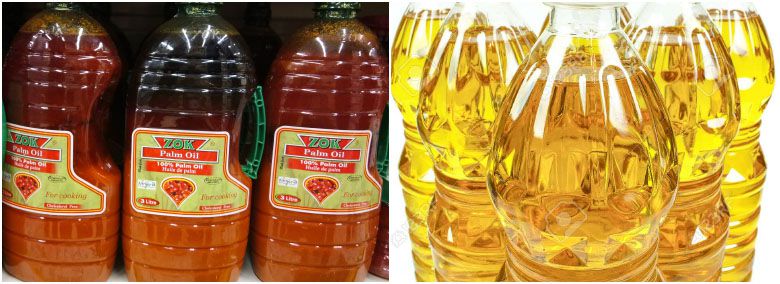

What is a Palm Oil Refinery?
As the name suggests, it is an Oil Refinery meant especially for Edible Oils. This means that the crude palm oil must be processed with palm oil refinery plant. After refining, the flavor, color and smell of edible oil is improved, the stability is improved which is good for long time storage, the smoke point of oil is increased.
Our company, QIE Group, devotes to provide solutions for palm oil production and palm oil refining, including palm oil mill plant layout design, palm oil equipment manufacturing, palm oil equipment debugging and installation.
Small Scale Palm Oil Refinery Plant in Nigeria
This small scale palm oil refinery plant mainly adopts batch type palm oil refining process to refine crude palm oil to get RBD palm oil. And then use special designed palm oil fractionation process to separate palm olein and palm stearin form RBD palm oil.
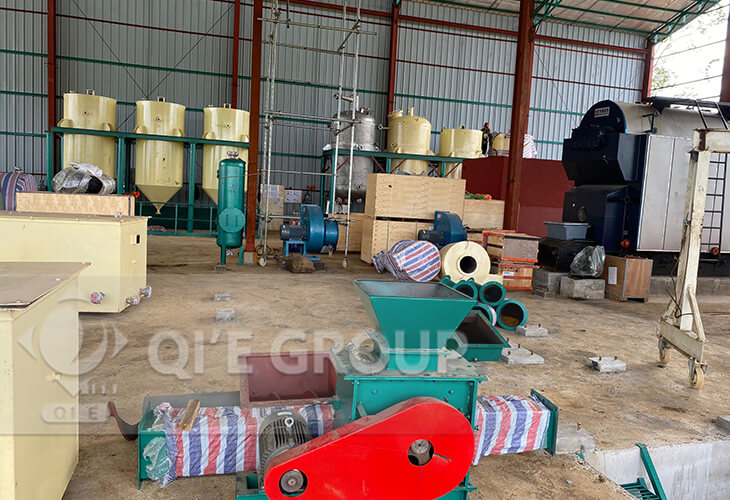
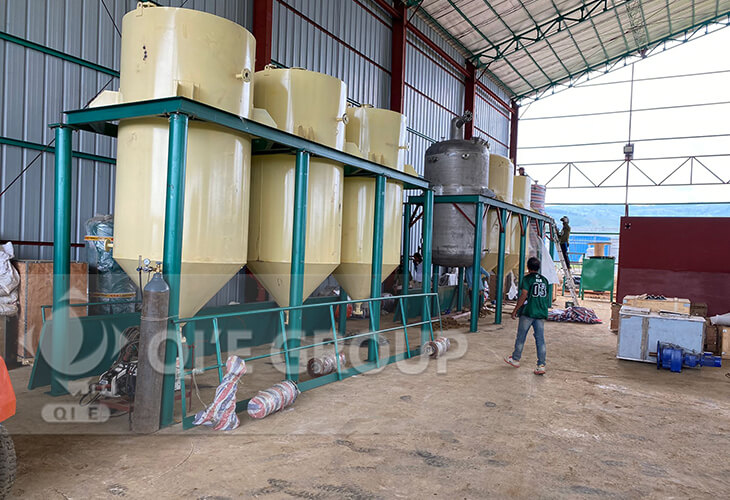
crude oil degumming (salt washed) -- - acid (alkali) - dephosphorization acid (refined), decoloring, bleach earth/ clay adsorption, dehydration (heating drying) deodorization ( vacuum distillation) -- dewaxing --get National standard first level refined oil :
1,degumming: Remove the colloid (mainly phospholipids) from the wool oil
2,decolorizing:Take the adsorption decolorization method to remove pigment in hair oil
3,deodorization:The odor material deodorization can remove hair oil
4,Take off the wax:The temperature is below 25 °C, good to take off the wax effect can be achieved after refining treatment , the colour and lustre of the oil is transparent, the oil will be stored for a long time there is no precipitation in it . When fried or deep fried the pan doesn't have a foam, there is no lampblack, reached to the standards for edible oil, can be directly filling to sale in the market , suitable for processing and small-scale oil processing plan.
Large Scale Palm Oil Refinery Plant in Nigeria
In order to achieving a good quality of Palm Oil ( good Taste, Good Odor , Good Appearance and storage easily.), The Crude soybean oil obtained by screw pressing and solvent extraction of soybeans will be sent to refinery to refining ( Degumming, Alkali Refining; Bleaching; Deodorizing; Dewaxing( some edible oil); fractionation ( some edible oil)
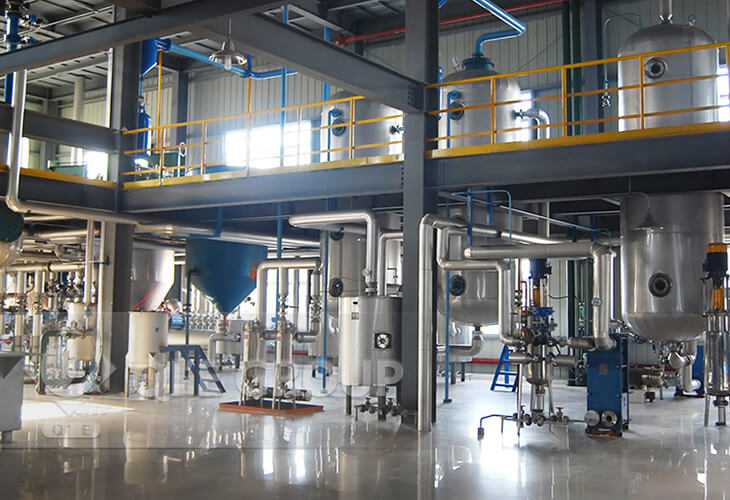
Inputting Capacity: 5TPD ---1000TPD Inputting
Raw materials: Palm Oil
Palm Oil Refining --Degumming
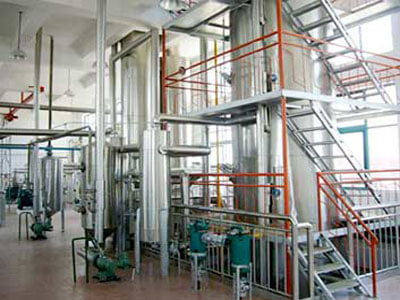
Crude Red Palm Oil contain gums, or gum like material. These consist largely of different carbohydrates, proteins and nitrogen compounds, and can be divided into hydratable and nonhydratable gums.If these are not removed before the fat or oil is exposed to the high temperatures used in deodorization or deacidification/deodorization, quality problems can well emerge. This is because the gum can give rise to problematic emulsions that in turn result in a significant waste of oil that could otherwise provide revenue.Water, chemicals or enzymes These gums can be removed using either water degumming, other specialist degumming and special degumming processes. Hydratable gums can be removed using water, because they absorb water and then become insoluble in oil. They are then removed using centrifugation .
Nonhydratable gums, on the other hand, are normally removed using a form of acid hydrolysis or caustic soda neutralization – phosphoric acid is the most common because it is the most cost effective. Adding such acids also helps remove any trace metals by making them form insoluble complexes.
Main Equipment of Degumming & Neutralization
Buffer tank
Blending Device
Centrifuge Separator
Heat Exchanger
Palm Oil Refining--Bleaching
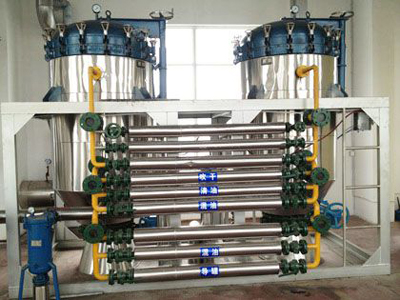
Bleaching is one of the key processes in palm Oil refinery, designed to remove not only pigments, but also a wide range of other impurities. Most crude fats and oils contain impurities that have to be removed for both commercial and health reasons. Modern industrial bleaching technologies are the way to do this.
Main Equipment of Bleaching
Heat excahnger
Bleacher
Blending Device
Leaf Filter
Palm Oil Process--Deodorization
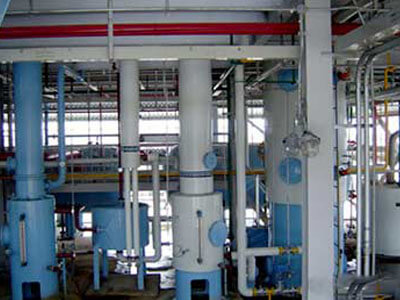
Deodorization is an absolute necessity in processing palm oil fats and oils. How efficiently it is done determines what you can achieve in your processing operations as a whole, in terms of removing odours, pigments and volatile substances.
When processing palm oil and animal fats, it is crucially important to remove any undesirable compounds that can affect flavour, odour, stability and colour. Deodorization is a vacuum steam distillation process in which steam is passed through such oils at very low pressure and relatively high temperature in order to remove any such substances still present after the preceding processing stages.
Main Equipment of Deodorization
Dearator
Heat Exchanger
Deodorizing Tower ( Packing structure)
Free fatty Acid Recovery device
Palm Oil Refining ---Dry Fractionation
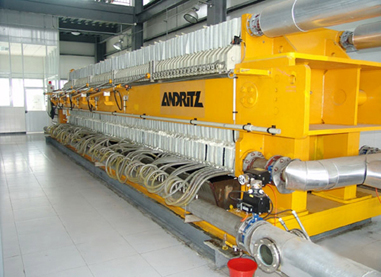
In edible oil processing, a fractionation process consists of a controlled cooling of the oil, thereby inducing a partial, or ‘fractional’, crystallization. The remaining liquid (olein) is then separated from the solid fraction (stearin) by means of a filtration or centrifugation.
If you plan to start a palm oil refinery business in Nigeria, If you want to learn more details of palm oil refinery plant. You are welcome to tell us your plan and let us help you start your own palm oil refinery factory that no matter it is 1tpd, 2tpd, 5tpd, 10tpd, 20tpd, 30tpd, 50tpd...
Analysis of Vegetable Oil Production Market in Nigeria:
| Oil | Palm Oil & Palm Kernel Oil | Soybean Oil | Rapeseed Oil | Sunflower Seed Oil | Peanut Oil | Cottonseed Oil | Others |
| Market Share | 32.0% | 22.4% | 13.1% | 8.0% | 2.1% | 2.7% | 19.7% |
Oil palm is the most important crop in Nigeria, so setting up a small sacle palm oil processing plant in Nigeria would minimize the cost on raw material purchase and transportation. What's more, Nigerian people have great demand of crude palm oil. It means setting up a palm oil processing plant in Nigeria is a profitable business.